
For many musculoskeletal conditions, exercise is now one of the recommended first-line treatments. But it has to be adapted, appropriately dosed, and supervised, not done at random. That is part of what the term exertherapy covers.
This article explains what exertherapy is, who it is for, how a program works, what the research has actually measured, and what Swiss health insurance covers.
Key points
- Exertherapy is rehabilitation through adapted, progressive, and supervised exercise. It is not a fitness program.
- It rests in particular on three pillars: an initial assessment, an individual program, and regularly assessed progression.
- In people with knee osteoarthritis, exercise can reduce pain and improve function to a clinically meaningful degree.
- Available evidence does not indicate that appropriately adapted therapeutic exercise damages cartilage. On the contrary, maintaining strength and functional capacity plays an important role in joint health.
What exactly is exertherapy?
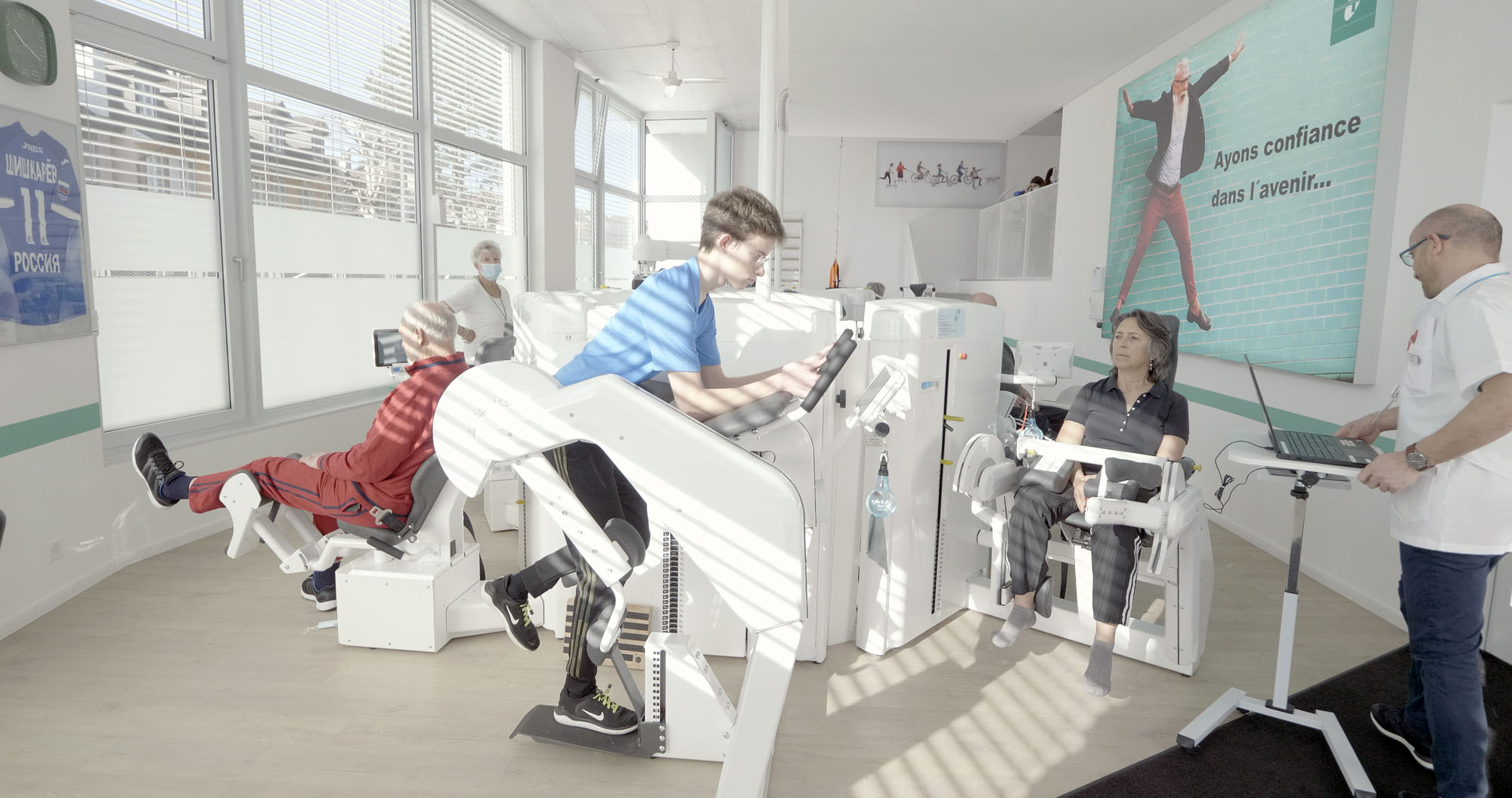
Exertherapy is the management of a musculoskeletal problem through a program of adapted, progressive, and supervised exercises. The term corresponds to what the international literature calls exercise therapy. Several elements set it apart from ordinary physical activity:
- An individual program. The program comes out of an assessment (strength, range of motion, balance, pain), not a standard catalogue.
- An adapted dose. Load, number of repetitions, frequency, and duration can be defined and adjusted according to the goals and the patient’s progress.
- Supervision. A professional corrects execution, adjusts the load, and guides progression.
The term “exertherapy” is not regulated in Switzerland. It describes a method, not a professional title. The way it is implemented can therefore vary between providers. At Dr.E., it is based on an initial functional assessment, an individualized program, regular measurements of progress, and medical supervision.
How is it different from conventional physiotherapy and from the gym?
Exertherapy is a form of physiotherapy, not a competing discipline. The difference lies mainly in the role exercise plays in the treatment. Physiotherapy covers a wide field: manual therapy, massage, lymphatic drainage, pain-relieving techniques, and respiratory or vestibular rehabilitation. In exertherapy, active exercise is at the heart of the treatment. The aim is to progressively develop the capacities the patient needs: strength, mobility, balance, endurance, or movement control.
The difference from the gym is of another kind. Fitness primarily aims to improve general physical condition. Exertherapy addresses a health-related goal, starts with a functional assessment, and takes place under the supervision of a physiotherapist. At Dr.E., it also benefits from medical supervision, allowing the program to be linked to the diagnosis and, where relevant, to a surgical procedure.
Who is exertherapy for?
Exertherapy can be indicated in a range of situations that share the need to restore or improve certain physical capacities.
- After orthopedic surgery. Knee or hip replacement, ligament reconstruction, shoulder surgery. Supervised progressive exercise supports functional recovery. We cover the knee in detail in our article on knee rehabilitation after surgery.
- Knee and hip osteoarthritis. International guidelines place structured exercise among the core treatments for osteoarthritis and generally recommend non-surgical approaches as first-line treatment (OARSI, 2019).
- Tendinopathies: Achilles tendon, patellar tendon, and rotator cuff. Progressive loading is one of the main therapeutic approaches for many tendinopathies. Prolonged rest can contribute to deconditioning.
- Return to sport after injury. Rehabilitation, followed by objective return-to-sport criteria and prevention of recurrence.
- Age-related muscle loss and fall prevention. Strength and balance can be measured and trained. In older people living at home, exercise programs reduce the number of falls by about a quarter (Sherrington et al., Cochrane, 2019). Strength training can also be particularly valuable at certain stages of life, including around menopause, when preserving muscle and bone mass becomes increasingly important.
Are there contraindications? Yes. Certain acute or unstable medical conditions, as well as specific post-operative instructions, may require some exercises to be adapted or postponed. The initial assessment and, where necessary, medical advice help determine the appropriate approach for each patient.
How does an exertherapy program work?
A structured program can be organized around five stages. The actual duration depends on the indication and the starting level.
-
- The initial assessment. Strength, range of motion, and balance tests, with measured values that serve as a reference. These measurements can then be used to objectively assess progress throughout treatment.
- A functional goal. Climbing stairs without holding on, running again, and regaining shoulder range of motion. Goals are defined according to the patient’s needs and priorities.
- An appropriately dosed prescription. Load, sets, repetitions, weekly frequency, and progression criteria.
- Supervised sessions and measured progression. The program is regularly adjusted according to the patient’s progress and the measurements taken.
- Reassessment, followed by a transition towards independence. The same tests as at the start are used to assess progress and adapt the program that can then be continued more independently.
What does the research say about exertherapy?
The evidence is particularly extensive in certain areas, including knee osteoarthritis.
On pain and function. The reference Cochrane review, which pools 54 studies, concludes that exercise reduces knee osteoarthritis pain by about 12 points on a 100-point scale and improves physical function by about 10 points immediately after treatment (Fransen et al., Cochrane, 2015). The authors compare this effect size to that reported for oral painkillers and anti-inflammatory drugs. Exercise also has the advantage of being suitable for continued use over time and contributes to maintaining strength and functional capacity.
On supervision. The way exercise is supervised and dosed can influence outcomes. In knee osteoarthritis, a meta-analysis found greater effects on pain with more frequently supervised exercise programs (Juhl et al., Arthritis & Rheumatology, 2014). The analysis also suggests that programs focused on specific goals may be beneficial.
Compared with surgery. In middle-aged adults with a degenerative meniscus tear, a supervised exercise program gave knee function at two years comparable to that obtained after surgery, with a better thigh strength gain at three months (Kise et al., BMJ, 2016).
In real-world conditions. The Danish GLA program, which combines education sessions with a supervised exercise program, has been followed in thousands of osteoarthritis patients outside clinical trials. Reported outcomes include reductions in pain and improvements in function (Skou and Roos, BMC Musculoskeletal Disorders, 2017).
Can exercise damage the joint?
The available evidence is reassuring. A systematic review of randomized trials found that therapeutic exercise has not been shown to have harmful effects on knee cartilage in people at risk of osteoarthritis or already affected, with some findings even suggesting potentially beneficial effects on cartilage composition (Bricca et al., British Journal of Sports Medicine, 2019).
The idea that “osteoarthritis is wear and tear, so the joint should be spared” can lead people to reduce physical activity excessively. Maintaining muscle strength and functional capacity contributes to healthy joint function. The aim is therefore to find an appropriate, progressive level of loading based on each person’s individual situation.
How many sessions, and is exertherapy covered by Swiss insurance?
Exertherapy can be covered as part of physiotherapy under Swiss basic health insurance when it is provided by a recognized physiotherapist and prescribed by a doctor. One prescription covers a maximum of 9 sessions; treatment must start within 5 weeks of the prescription, and the prescription remains valid for 3 months. Beyond 36 cumulative sessions, specific provisions apply if treatment needs to continue. The annual deductible and the usual co-payment apply as for other services covered by basic health insurance. In the case of an accident, cover may fall under accident insurance (LAA).
How long does it take, in practice? This depends on the condition, the patient’s goals, and their progress. Some structured programs studied in osteoarthritis extend over several weeks. After surgery, rehabilitation may continue for several months. Consistency and the exercises carried out between sessions can also play an important role. The details of what is covered are in our frequently asked questions.
How it works at Dr.E. in Pully
At Dr.E. by Swiss Ortho Clinic, the assessment always comes before the exercise program is prescribed. Strength and balance tests provide measured reference values; you can find out more on our test your strength and test your balance pages. Sessions then take place on connected strengthening machines that record every repetition, and the same tests are repeated at regular intervals. The whole pathway is described in our therapeutic management process.
Medical supervision is provided by Dr Santiago Echeverri, FMH orthopaedic surgeon. For patients operated on within Swiss Ortho Clinic, rehabilitation is built directly on the operative report, which facilitates continuity between the surgical and rehabilitation teams.
An initial assessment determines the program best suited to your situation and goals. A medical prescription for physiotherapy is required for coverage by basic health insurance. To schedule an assessment, contact the center.
Frequently asked questions about exertherapy
Is exertherapy different from strength training?
Yes. Strength training is a form of exercise that can have a range of goals, including improving strength, general fitness, or performance. In exertherapy, strengthening exercises can be used for a therapeutic goal defined after an assessment, with an adapted load and professional supervision.
Do I need to be sporty to start?
No. The program starts from the level measured at the initial assessment, whatever it is. General physical activity recommendations are a long-term goal, not a prerequisite.
Could exercise make my osteoarthritis worse?
Available evidence does not indicate that appropriately adapted therapeutic exercise damages cartilage. An adapted, progressive, and supervised program takes pain and the individual situation into account. Some acute situations require certain exercises to be adapted or postponed: the assessment helps determine what is appropriate in each case.
Do I need a medical prescription?
Yes, for cover by basic health insurance. The prescription is valid for 3 months, treatment must start within 5 weeks, and each prescription covers a maximum of 9 sessions. Specific provisions apply when treatment needs to continue beyond several series of sessions.
This article is for information only. It does not replace an individual medical consultation and is neither a diagnosis nor a promise of results. Any treatment is decided after a clinical examination.
Sources
- Fransen M et al. Exercise for osteoarthritis of the knee. Cochrane Database of Systematic Reviews, 2015. doi.org/10.1002/14651858.CD004376.pub3
- Juhl C et al. Impact of exercise type and dose on pain and disability in knee osteoarthritis. Arthritis & Rheumatology, 2014. PMID 24574223
- Skou ST, Roos EM. Good Life with Osteoarthritis in Denmark (GLA:D). BMC Musculoskeletal Disorders, 2017.
- Kise NJ et al. Exercise therapy versus arthroscopic partial meniscectomy for degenerative meniscal tear in middle-aged patients. BMJ, 2016. PMID 27440192
- Bricca A et al. Impact of exercise on articular cartilage in people at risk of, or with established, knee osteoarthritis. British Journal of Sports Medicine, 2019.
- Bannuru RR et al. OARSI guidelines for the non-surgical management of knee, hip, and polyarticular osteoarthritis. Osteoarthritis and Cartilage, 2019.
- Sherrington C et al. Exercise for preventing falls in older people living in the community. Cochrane Database of Systematic Reviews, 2019.
- physioswiss and FMH frequently asked questions on physiotherapy reimbursement (LAMal).