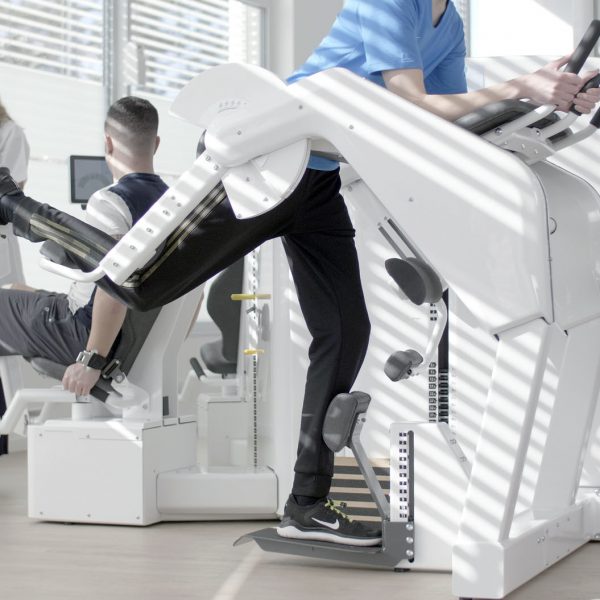

Surgery repairs the joint. It does not immediately restore normal knee function. In the month after a knee replacement, the quadriceps, the large muscle at the front of the thigh, loses a great deal of its strength. And this is not only because the muscle loses volume: it is also because it no longer responds properly to the signal from the nervous system. Rehabilitation first aims to restore good muscle activation, then to rebuild strength, one stage at a time.
This article explains what happens inside an operated knee, how long recovery really takes, and which criteria decide when you move on to the next stage.
Key points
- A knee that no longer hurts can still be a weak knee. The weakness of the first weeks comes mainly from the muscle not being activated, not only from loss of muscle mass.
- Everyday movements come back in weeks, strength in months. A year after a knee replacement, the quadriceps has often still not recovered its full strength.
- You move from one stage to the next when a measured criterion is met, not simply because a certain amount of time has passed.
- The end of the prescribed sessions does not necessarily mark the end of the work. It may mark the transition to a more independent program, which still needs to progress gradually.
Why does the knee stay weak when it no longer hurts?
Because loss of strength is not explained solely by loss of muscle mass. In the reference study on the subject, one month after a total knee replacement, quadriceps strength had dropped by 62%, while the size of the muscle had decreased by only 10% (Mizner et al., Journal of Bone and Joint Surgery, 2005). Most of the loss came from a failure of activation: the brain could no longer fully recruit the muscle.
That distinction changes the way rehabilitation is approached. A muscle that has lost volume needs to be progressively strengthened. When a muscle is inhibited, the initial goal is to restore good muscle activation: voluntary contractions from the first days, working towards full extension, and controlling pain and swelling, which can both contribute to maintaining that inhibition.
This phenomenon can persist for months after surgery, even when pain has decreased. Objective strength testing can help identify it.
How long does knee rehabilitation take?
Recovery can continue well beyond the first series of physiotherapy sessions. A review of 21 studies found that one year after a total knee replacement, the quadriceps reaches only 70 to 80% of the strength of people of the same age who have not had surgery (Archives of Orthopaedic and Trauma Surgery, 2023).
It helps to separate three timescales that are easily confused:
- Everyday movements (walking, climbing stairs, driving) are generally regained over several weeks, depending on the type of surgery and the patient’s progress.
- Strength comes back in months.
- Symmetry between the two legs can take much longer and is not always fully restored.
In practical terms, when the prescribed sessions end, strength work may still need to continue. Depending on the situation, the patient may gradually move from close supervision to a more independent program, which should remain adapted and progressive.
The four stages of knee rehabilitation after surgery
The stages below provide general guidance, particularly after a knee replacement. Their duration and content must be adapted to the type of surgery, the surgeon’s instructions, and each patient’s progress. Functional criteria help guide progression from one stage to the next.
Stage 1, the first two weeks: restoring good muscle activation
During the first few weeks, one of the main goals is to restore good quadriceps activation while gradually working on knee mobility. Voluntary quadriceps contractions, actively working towards full extension, controlling swelling and pain, and early walking with support. Gradually regaining full knee extension is also an important goal during this first phase.
Criteria for moving to stage 2: extension close to zero, a quadriceps contraction without compensation, walking on flat ground with suitable support, and swelling and pain under control.
Stage 2, weeks two to six: gradually restoring mobility
The first few weeks are particularly important for gradually regaining flexion. After a knee replacement, a large proportion of the improvement in flexion observed during the first year occurs within the first six weeks (The Journal of Arthroplasty, 2025). Mobility should be worked on regularly, not only on session days. Pedalling on a stationary bike can be introduced as soon as the range allows it.
Criteria for moving to stage 3: enough flexion for the everyday movements you are aiming for, extension maintained, walking without a limp at home, and beginning to use stairs with an alternating step pattern.
Stage 3, weeks six to twelve: rebuilding strength
Once mobility has recovered sufficiently, strengthening gradually becomes a central goal. Progressive strengthening on machines, pedalling, and balance work. This is also the time to gradually prepare for everyday movements that may still be difficult, such as kneeling or going down stairs without holding on.
Criteria for moving to stage 4: a documented increase in load on the knee extensors, holding your balance on one leg, going up and down stairs with an alternating step pattern, and walking for longer periods without exercise-related pain.
Stage 4, months three to nine: continuing to build strength
This phase allows strength work to continue even when pain has already decreased significantly. Strength work continues, largely with increasing independence while still being supervised as needed. For people aiming to return to sport, progression is based on functional criteria and testing, not only on the time elapsed since surgery.
Exit criterion: depending on the type of surgery and the patient’s goals, strength in the operated leg may be compared with that of the other leg. If returning to sport is the goal, additional hop and movement-control tests may also be used.
Knee replacement, anterior cruciate ligament, meniscus: same knee, different goals
After a total knee replacement. The goal is lasting, pain-free everyday function, not performance. Priority goes to full extension and gradually restoring quadriceps strength. One signal not to overlook: if mobility remains very limited in the first few weeks, particularly if the knee is still struggling to reach 90 degrees of flexion after about one month, it is important to discuss this with the surgeon so that the situation and possible options can be assessed (The Journal of Arthroplasty, 2026).
After anterior cruciate ligament reconstruction. Time since surgery alone is not enough to decide when to return to sport. In a cohort of athletes who had the operation, 38% of those who failed the return-to-sport tests were injured again, compared with 6% of those who passed them (Grindem et al., British Journal of Sports Medicine, 2016). And the other knee is involved too: after this operation, a second injury more often affects the non-operated leg than the operated one (Wiggins et al., American Journal of Sports Medicine, 2016). Rehabilitation therefore concerns both legs.
After a degenerative meniscus tear. The question often arises before surgery. In middle-aged adults, a supervised exercise programme gave results comparable to surgery at two years, with a better strength gain at three months (Kise et al., BMJ, 2016). In this specific situation, rehabilitation can be a treatment option, not only something that follows an operation. The decision is made with the surgeon, depending on the type of tear.
Why decisions are based on measurements, not dates
Measurements help objectify progress during rehabilitation. A strength and balance assessment at the start of a cycle provides a baseline and makes it possible, a few weeks later, to compare numbers rather than only impressions. The same tests are repeated at regular intervals. These values help determine whether the criteria for progression have been met and whether the training load should be adjusted.
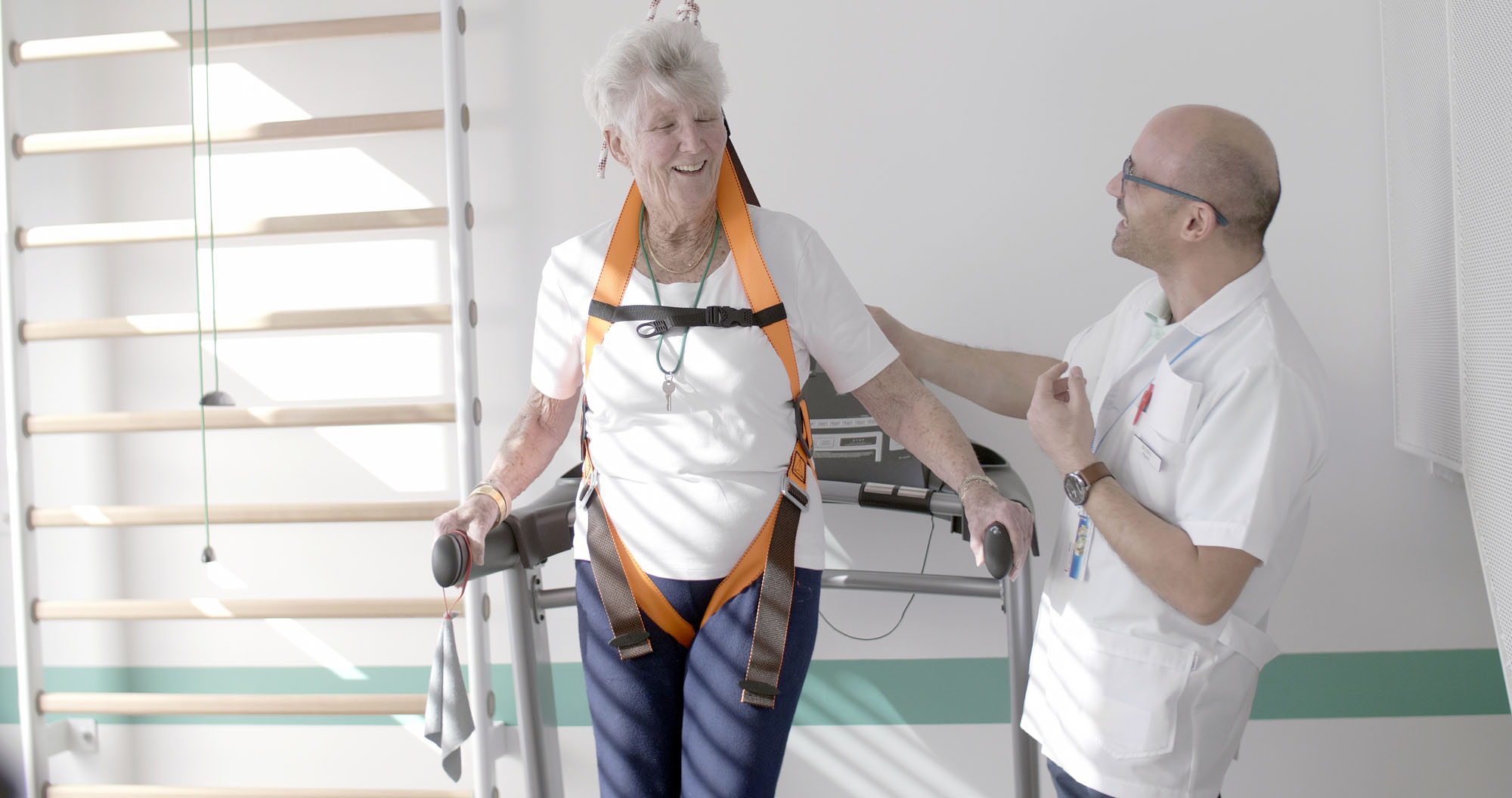
After a knee replacement, some devices such as continuous passive motion machines and certain cold-therapy devices have not shown a clear additional benefit in the available studies (Fortier et al., Journal of Bone and Joint Surgery, 2021). This does not mean that occasional use of cold has no place in symptom management. Progressive exercise and repeated active movement remain important parts of rehabilitation.
How many sessions do you need, and what does insurance cover?
Post-operative rehabilitation counts as physiotherapy under Swiss basic health insurance (LAMal): it is covered with a medical prescription. One prescription covers a maximum of 9 sessions, treatment must start within 5 weeks, and the prescription remains valid for 3 months. A new prescription allows you to continue.
The number of sessions is not the only parameter: frequency and consistency also matter. The frequency of sessions is adapted to the type of surgery, the stage of recovery, and the patient’s needs. Between sessions, prescribed home exercises may also be part of the treatment. The details of what is covered are in our frequently asked questions.
How knee rehabilitation works at Dr.E. in Pully
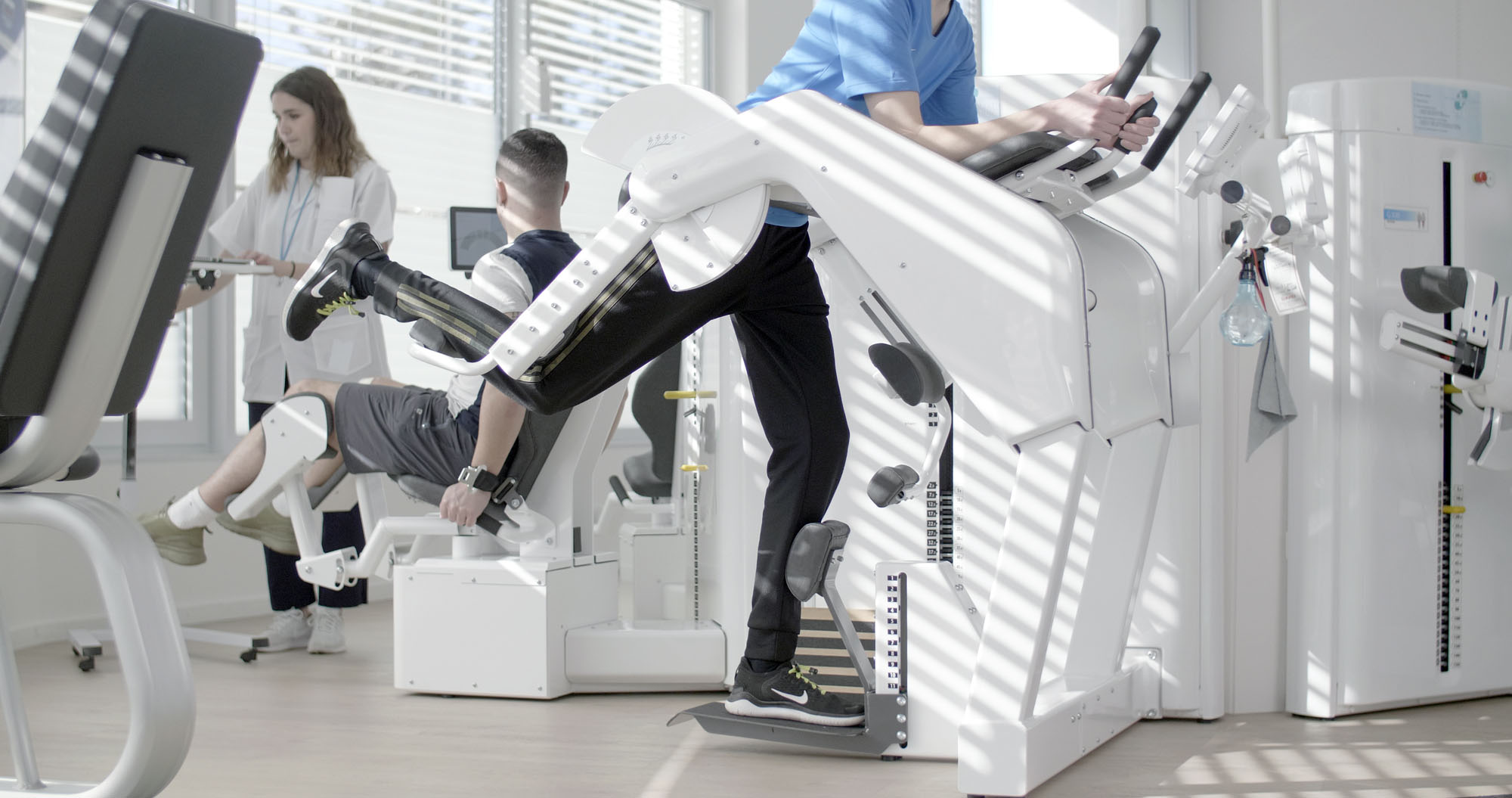
Every cycle starts with a measured assessment of strength and balance, which provides baseline values before the exercise programme is defined. Sessions take place on connected strengthening machines that record the actual load of every repetition. The same tests are repeated at set intervals, so that values are compared rather than only impressions. You can find out more on our test your strength and test your balance pages.
Medical supervision is provided by Dr Santiago Echeverri, FMH orthopaedic surgeon. For patients operated on within Swiss Ortho Clinic, the protocol is built directly on the operative report: the type of procedure and the surgeon’s instructions change the priorities of the first weeks.
This protocol does not promise a result. Its purpose is to monitor progress objectively: at each stage, measurements help determine whether the criteria needed to progress have been met. Post-operative rehabilitation requires a medical prescription for physiotherapy. If you have a prescription or a surgery date, contact the centre to schedule the initial assessment.
Frequently asked questions
How long does rehabilitation take after a knee replacement?
Everyday movements are generally regained over several weeks, while strength recovery continues for several months. A year after surgery, the quadriceps has often still not recovered its full strength. Strength work may therefore need to continue after the prescribed sessions have ended, with progressively more independence.
When can I return to sport after knee surgery?
The decision is based on a combination of time since surgery, the type of procedure, and measured functional criteria. After anterior cruciate ligament reconstruction, for example, strength in the operated leg is usually compared with the other leg and supplemented by hop and movement-control tests. These elements help determine whether a return to sport can be considered safely.
Why is my knee still weak when it no longer hurts?
Because the early weakness comes mainly from the muscle not being activated, and not only from loss of muscle mass. That inhibition can persist for months even when pain has decreased. It can be identified through strength testing and addressed during rehabilitation.
Are nine physiotherapy sessions enough after knee surgery?
It depends on the type of surgery and the patient’s progress. After some procedures, rehabilitation and strength work need to continue beyond an initial series of nine sessions. One prescription covers a maximum of 9 sessions, but a new prescription allows you to continue. The frequency of sessions, their consistency, and the work carried out between sessions also contribute to progress.
Does a meniscus tear always need surgery?
No, particularly in some degenerative tears in middle-aged adults. In that situation, a supervised exercise programme can provide results comparable to surgery at two years. The decision is made with the surgeon, depending on the type of tear and the individual patient’s situation.
This article is for information only. It does not replace an individual medical consultation and is neither a diagnosis nor a promise of results.
Sources
- Mizner RL et al. Early quadriceps strength loss after total knee arthroplasty. Journal of Bone and Joint Surgery, 2005. doi.org/10.2106/JBJS.D.01992
- Systematic review and meta-analysis of quadriceps strength after total knee arthroplasty (21 studies, 647 participants). Archives of Orthopaedic and Trauma Surgery, 2023.
- Gil JN et al. Impact of Range of Motion Trajectory on Patient-Reported Outcomes Following Total Knee Arthroplasty. The Journal of Arthroplasty, 2025. doi.org/10.1016/j.arth.2025.02.039
- Israelite C et al. Patients Undergoing Manipulation Under Anesthesia Recover Mobility, But Have Worse Functional Outcomes. The Journal of Arthroplasty, 2026. doi.org/10.1016/j.arth.2026.07.021
- Grindem H et al. Simple decision rules can reduce reinjury risk by 84% after ACL reconstruction. British Journal of Sports Medicine, 2016. PMID 27162233
- Wiggins AJ et al. Risk of Secondary Injury in Younger Athletes After Anterior Cruciate Ligament Reconstruction. American Journal of Sports Medicine, 2016.
- Kise NJ et al. Exercise therapy versus arthroscopic partial meniscectomy for degenerative meniscal tear in middle aged patients. BMJ, 2016. PMID 27440192
- Fortier LM et al. Activity Recommendations After Total Hip and Total Knee Arthroplasty. Journal of Bone and Joint Surgery, 2021. PMID 33337819
- FMH, frequently asked questions on physiotherapy under LAMal (sessions per prescription, deadlines, validity).