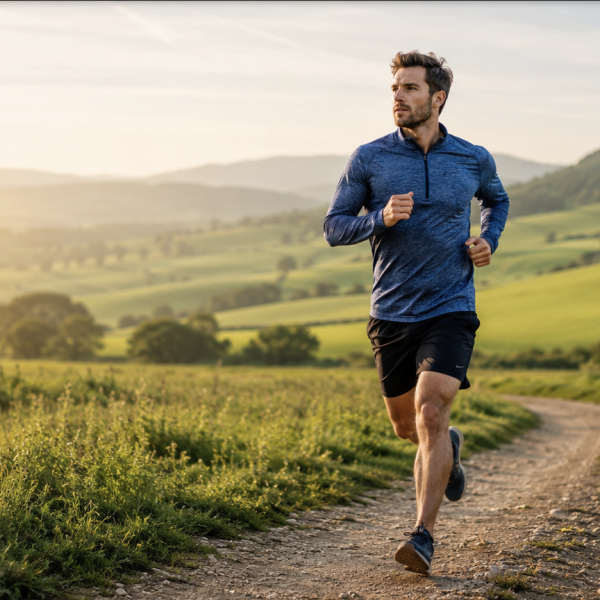

With the return of long, warm days, many of us start running, hiking or cycling again. That is excellent news for your health. The only trap is wanting to go too fast, too soon.
Every year at this time, we see the same injury come back through the centre: iliotibial band syndrome, better known as runner’s knee.
The good news? In the vast majority of cases, there is no need to stop training. With the right approach, you quickly get back to enjoying movement.
How do you recognise it?
Runner’s knee almost always shows up the same way: pain on the outer side of the knee that appears after twenty to thirty minutes of effort, gets worse downhill or on uneven ground, and disappears at rest only to return on your next outing. If that sounds familiar, you are far from alone: it is one of the most common complaints among people getting back into running.
Why does it happen?
Contrary to what people often assume, it is almost never a lack of fitness. The main cause is coming back too quickly. Several factors combine: a sudden jump in distance or pace, a lack of strength in the hips and glutes that stabilise the knee, unsuitable terrain or worn-out shoes. The real problem often sits a little higher up, at the level of the pelvis.
Do you have to stop running?
In most cases, no. Stopping completely relieves the pain in the moment, but it does not correct the cause. What works is a progressive approach: temporarily reducing the load rather than stopping everything, strengthening the hips and glutes, returning in stages by increasing distance little by little, and adjusting a few details in your running form and equipment. Caught early, runner’s knee usually settles within a few weeks.
When should you seek advice?
If the pain persists despite rest, forces you to limp, or comes back on every run, it is time to talk to someone. An assessment identifies where the imbalance comes from and allows us to put a tailored programme in place.
The team at the Dr.E. physiotherapy and exertherapy centre
Dr.E. by Swiss Ortho Clinic, Prieuré 13, 1009 Pully — info@dr-e.ch